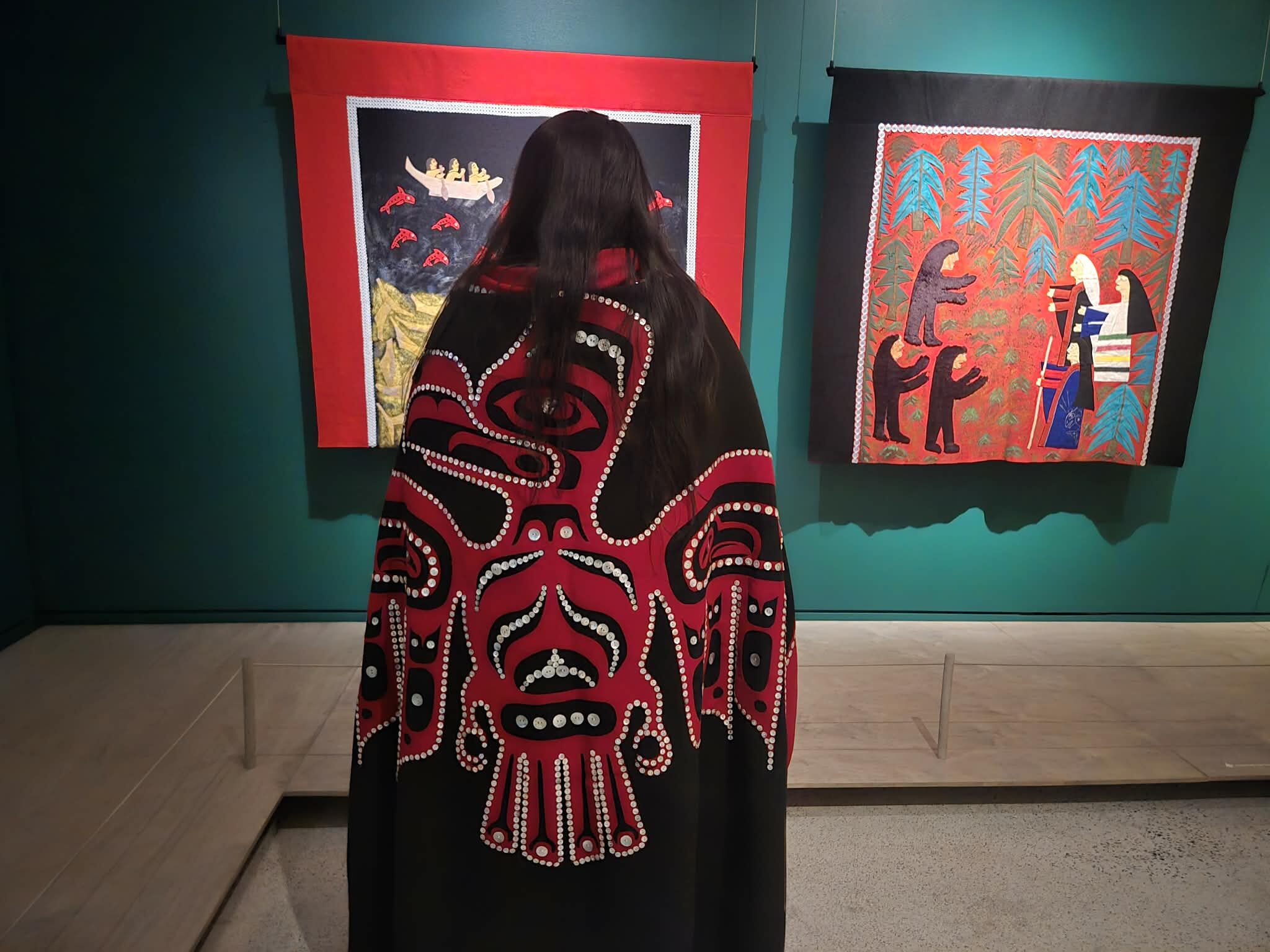

For National Indigenous Peoples Day, Coast Capital’s Candice Moore, who co-chairs our Indigenous Employee Resource Group, shares a personal reflection on her grandmother, Haida artist Jut-ke-Nay Hazel Wilson, and the exhibit of her work now at the Museum of Anthropology.
Seeing Through Her Eyes: Honouring My Grandmother, Jut-ke-Nay Hazel Wilson
There are moments in life when pride feels almost too big to hold quietly. Walking into the Museum of Anthropology and seeing my grandmother’s work on display was one of those moments.
Remembering Grandma Hazel
My grandmother, Jut-ke-Nay—Hazel Wilson—was the matriarch of our family. She was strong, endlessly dedicated, and had a quiet sense of humour that lived just beneath everything she did. I knew her as Grandma Hazel. And like many grandparents, she seemed to always be working—her hands busy, her focus steady, her blankets slowly taking shape over time. Growing up, I wasn’t as close to her as I sometimes wish I had been. But connection doesn’t always follow a straight path. For me, it found its way through art.
A Living History in Fabric
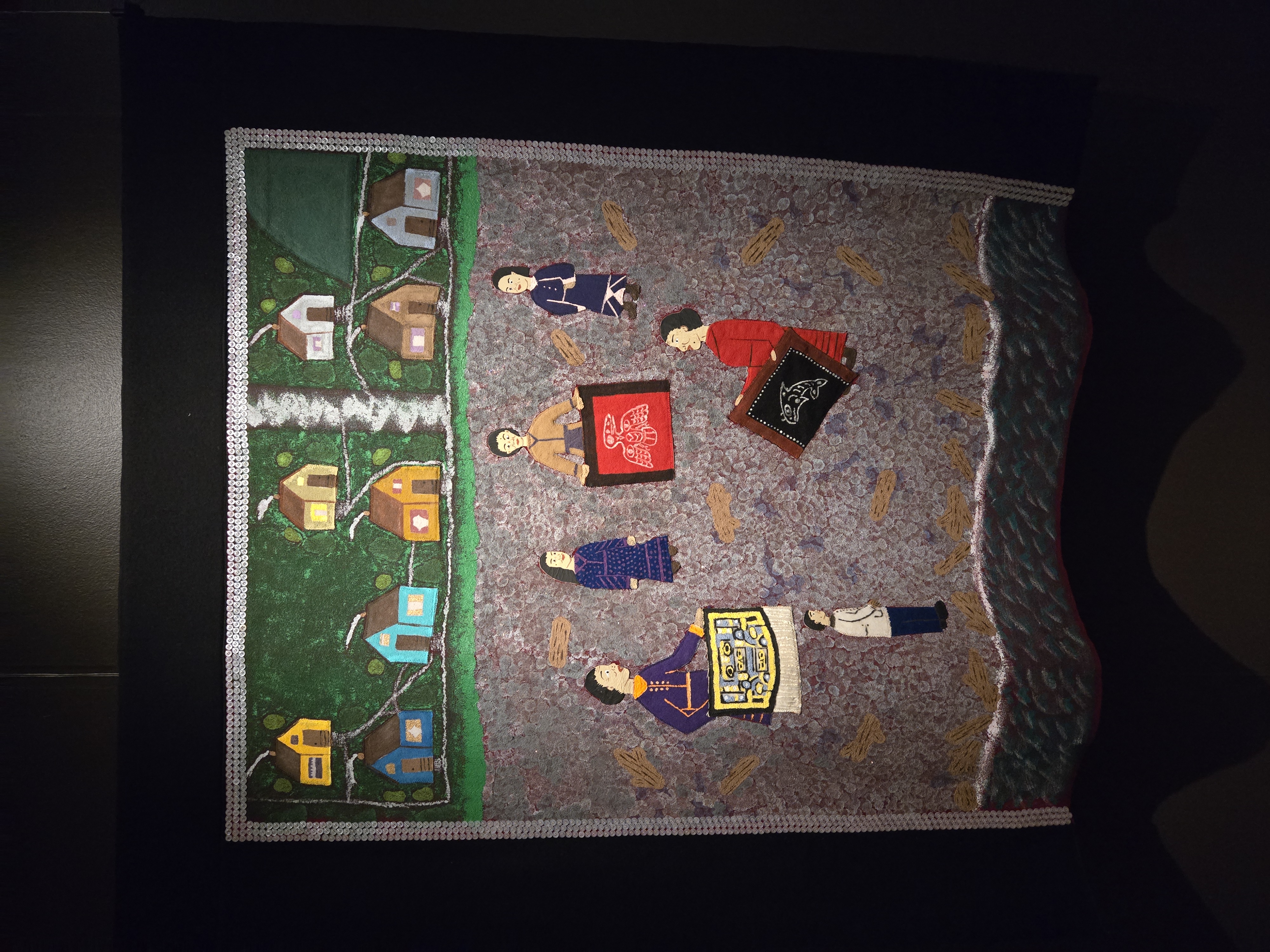
I Use My Haida Eyes, brings together a remarkable series of 51 “history robes”—each one telling a story grounded in Haida history, experience, and identity.
Created between 2005 and 2006, these robes are more than visual works—they are living records. They depict moments stretching from ancestral Haida stories before contact, to encounters with European explorers, to memories rooted in her own life: gathering, harvesting, and moving across the lands of Haida Gwaii.
Each robe carries detail, intention, and voice. Together, they tell history from a Haida perspective—something that feels both deeply personal and profoundly important.
Tradition, Resilience, and Innovation
What stands out most is how her work honours both continuity and change. Inspired by traditional button blankets of the Northwest Coast, her robes hold familiar forms, yet push beyond them—into storytelling, into history, into something entirely her own. They reflect the resilience of Haida people, the persistence of culture, and a connection to land and knowledge that continues to endure.
Finding Connection Through Art
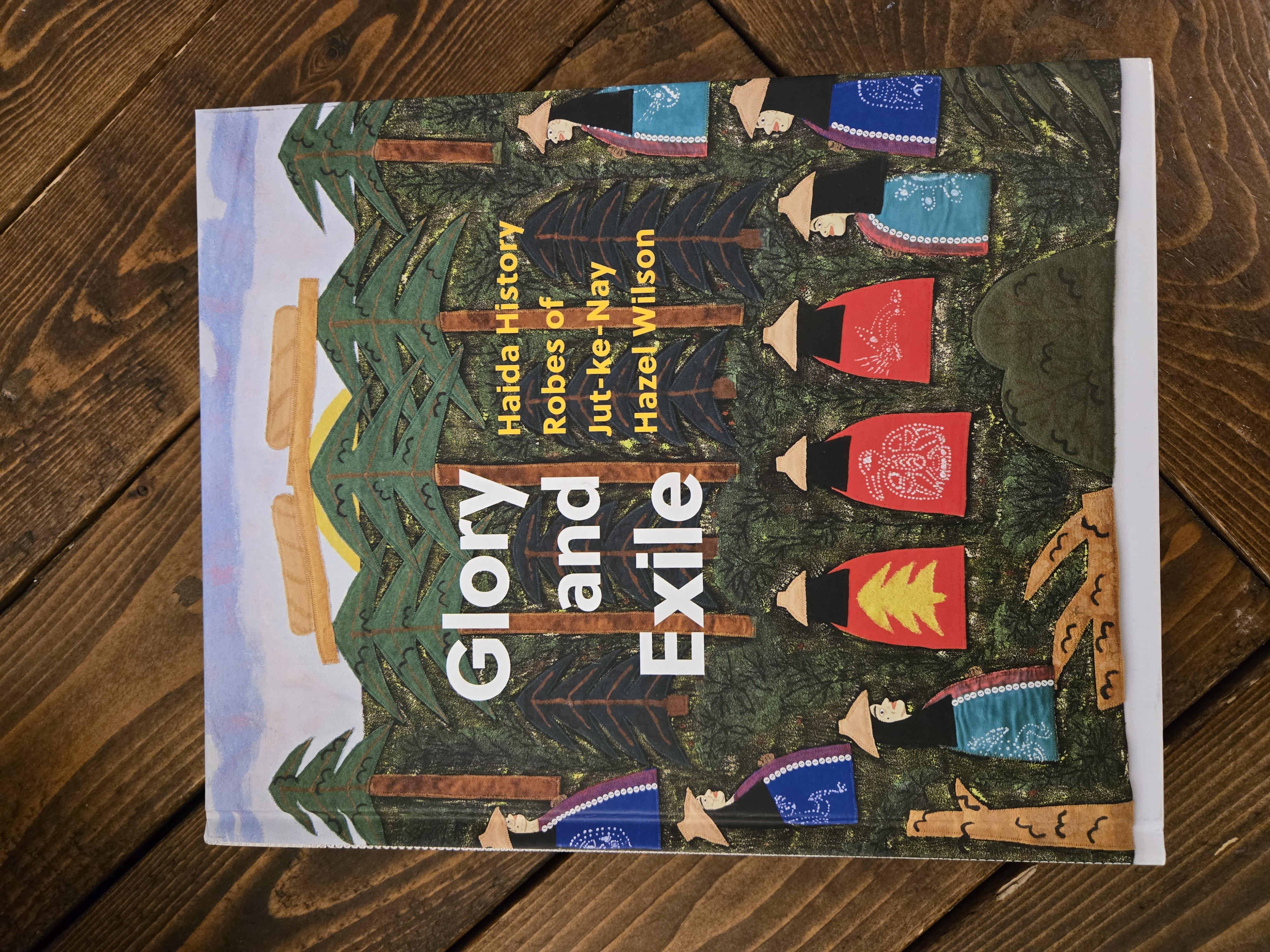
As an artist myself, this is where I feel closest to her. I recognize the dedication it takes to keep showing up to your work. The patience. The quiet discipline. The way art becomes not just something you make, but something you live with—something that shapes how you see the world. Even without a lifetime of shared conversations, I feel connected to her through that understanding. Through the act of creating. Through the influence that exists without needing to be spoken out loud. In her work, I can see the care, the commitment, and the perspective that guided her. And in my own way, I carry that forward.
A Moment of Pride
Standing in the museum, surrounded by her robes—many of which have never been shown publicly before—I felt something overwhelming. Pride for her, Pride for my family, Pride for our Haida culture, Pride for Indigenous art in all its forms. There is something powerful about seeing Indigenous stories told on our own
terms—about seeing them given the space, respect, and visibility they deserve. This exhibit does exactly that. It brings together not just her work, but her full vision. And it honors a truth that runs through every robe: that our stories continue, that our cultures are alive, and that our ways of seeing the world remain strong.
Carrying the Legacy Forward
As we recognize National Aboriginal Peoples Day on June 21st, I find myself thinking about legacy—not just as something we inherit, but something we actively live and carry forward.
My grandmother’s work reminds me that connection can take many forms. Even across time, distance, or unspoken words, there are ways we find each other. Sometimes, it’s through stories, sometimes, it’s through land and sometimes, it’s through art. Through her “Haida eyes,” she created something lasting. Something that continues to speak, to teach, and to inspire. And through my own, I’m still learning to see.
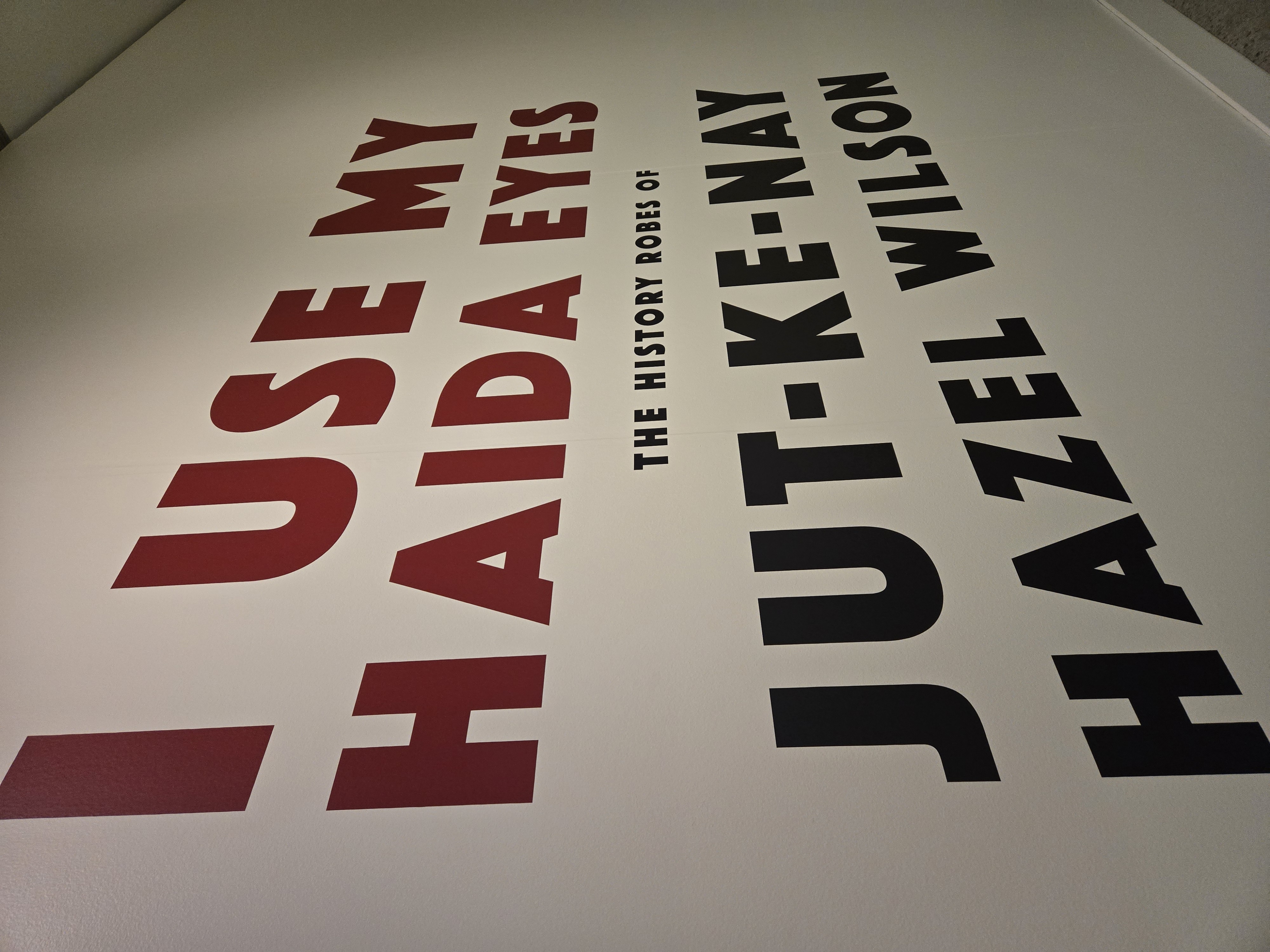
“I Use My Haida Eyes” is on view at the Museum of Anthropology at UBC in Vancouver through October 12, 2026. Visitor details are at moa.ubc.ca.